
Most of the speculation before the Budget is about which taxes John Healey might raise. How much he needs to raise depends first on a judgement he does not make himself. On 28th October the Office for Budget Responsibility (OBR) will publish its first forecast since the war in Iran pushed up energy prices. Its view of how fast the economy and wages grow will move the public finances by more than most of the tax measures under discussion.
This article was written by Bradshaw Economics Chief Economic Adviser Andrew Morrison.
How growth feeds through to the fiscal rules
The Chancellor’s main fiscal rule requires day-to-day spending to be covered by revenues in 2029–30. A separate rule requires public sector net financial liabilities to fall as a share of GDP. For this Budget, the key question is how developments now change the outlook for revenues and spending three years ahead.
‘Headroom’ is the amount by which forecast revenues exceed day-to-day spending in that target year. In March, the OBR put these at about £1,490bn and £1,470bn respectively. A 1% change in either total would therefore move headroom by around £15bn.
On the revenue side, taxes are levied on cash values, so receipts rise with both real growth and inflation. Income tax and National Insurance raise almost half of total tax revenue, which makes earnings the key judgement: the IFS estimates that earnings growing 1 percentage point faster over the forecast adds about £8bn. Last November the OBR's 0.3 percentage point cut to its productivity assumption cost about £16bn.
On the spending side, most benefits are uprated with prices and so rise with inflation, debt interest rises with interest rates, and departmental budgets are fixed in cash, so inflation reduces what they buy rather than what they spend.
The growth forecast therefore works mainly through revenues. Productivity, employment and wages all feed directly into what the government expects to collect. Slower growth hits revenues more directly than spending. Departmental budgets are fixed in cash. Benefits and debt interest depend more on prices, claimant numbers and interest rates.
Three kinds of growth
'Growth' isn't just one thing, there are several measures that the OBR predicts the 'growth' of in its forecast.
Productivity. Productivity is how much the economy produces for each hour someone works. The OBR assumes it will grow by 1% a year in the medium term. This is a key judgement because sustained growth in real wages depends on workers producing more per hour. Higher productivity gives firms scope to raise pay without increasing prices or squeezing profits. Stronger wages, in turn, support income tax receipts.
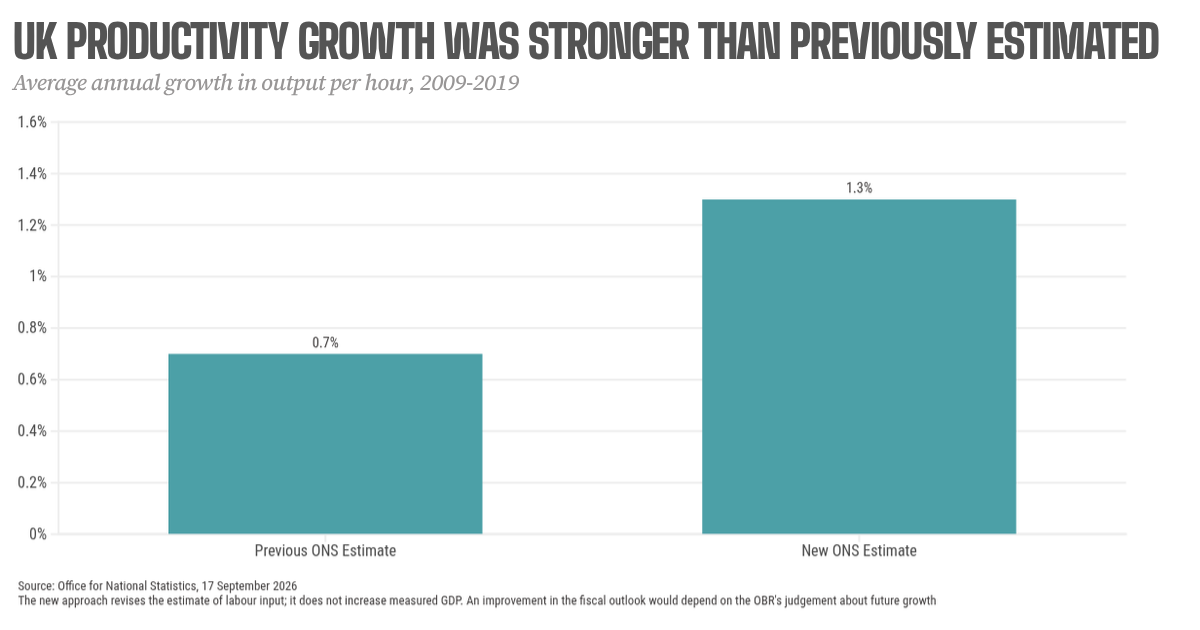
In September the ONS revised its estimate of productivity growth in the decade before the pandemic from 0.7% to 1.3% a year. The revision mostly reflects fewer hours worked rather than more output. As such, it does not change the size of the economy. The revised figures give the OBR reason to reconsider its productivity assumption, although any increase could be offset by a weaker outlook for working hours. We share the Resolution Foundation’s assessment that a significant change at this Budget is unlikely.
GDP. GDP is the total value of everything the economy produces. It grows when each worker produces more (covered above) or when more people are in work, so growth in the working population adds to GDP and to tax receipts. Recent ONS projections put net migration at about 230,000 a year, around 60,000 below the OBR's March assumption, and visa data suggest a sharper fall this year. As a rule of thumb, every 100,000 workers add about £1.5bn a year in taxes on income. Employment has so far been stronger than the OBR expected, which offsets some of this. Lower migration could reduce tax revenues by several billion pounds. The effect will depend on how far the OBR revises its forecast and when it expects the reduction to occur.
GDP per capita. GDP per capita is GDP divided by the population, the simplest measure of average living standards. It is what voters experience and what the government's growth agenda will be judged on, but it barely features in the fiscal rules. Lower migration could leave GDP per head unchanged, or slightly higher if those leaving are lower earners, while still reducing headroom. A government that wants both lower migration and a stronger fiscal position needs output per worker (productivity) to make up the difference.
Inflation raises receipts as well as costs
The war in the Middle East has lowered the outlook for real growth but raised it in cash terms. In the Barclays forecast used in the IFS Green Budget, the economy in 2031-32 is 0.5% smaller in real terms than the OBR expected in March but 2% larger in cash terms. Inflation can help the tax take, especially with income tax thresholds frozen. The IFS expects receipts to rise by more than benefit costs, but much depends on wages keeping pace with prices.
Higher interest rates and inflation also add about £11bn to debt interest in 2029-30. Departmental budgets are set in cash, so inflation erodes what they buy, and restoring their real value would cost about £12bn a year in day-to-day spending by 2029-30. Borrowing in the five months to August was £8bn above forecast. The estimates vary widely. The IFS illustrates headroom of between £13bn and £37bn, depending largely on earnings assumptions, with a middle scenario of about £20bn. The Resolution Foundation and EY are less optimistic, putting it at around £12bn and £11bn respectively, roughly half the March figure.
What this means for Healey
The forecast itself may not force a tax rise. The harder problem is spending. As Defence Secretary, Healey called for defence spending of 3% of GDP by 2030. Higher defence spending would add several billion pounds to spending pressures, with the effect on current-budget headroom depending on the timing and the division between day-to-day and capital expenditure. Departments face real-terms cuts unless their budgets are topped up, and next year's Spending Review has to settle them. Reports that Healey wants a low-key Budget suggest he will leave those decisions to 2027. If the spending totals he sets now are not ones the government intends to stick to at the Spending Review, the forecast will flatter the outlook.
The growth forecast also limits what Healey can claim for his own policies. The OBR has been cautious about crediting policy with higher growth. Planning reform is one of the few measures it has scored, at 0.2% of GDP by 2029-30, and with housebuilding behind forecast it may revisit even that. New measures could also lift this Budget’s forecast, provided the plans are sufficiently detailed and the evidence convincing, although many benefits would take years to emerge.
At this Budget, the room Healey has depends more on the OBR's view of wages and inflation than on anything he announces.
