
As Healey’s inaugural Budget is approaching, there are questions about where and how taxation will lead us to a greater capacity and how that will influence future government expenditure.
Insights by Cicely Mallinson, Junior Economist
What is government expenditure?
The money spent by the government falls into one of two categories: annually managed expenditure (AME) and departmental expenditure limits (DEL). Together they make up total managed expenditure (TME). They sit under the same umbrella, but behave very differently, and the gap between them shapes what the Chancellor can afford to do.
Annually managed expenditure (AME) deals with spending on debt servicing, social welfare benefits, and pensions. AME responds to changes in the inflation rate, unemployment, and interest rates, all of which can change at the drop of a hat, making it volatile and demand-led.
Departmental expenditure limits (DEL) refer to reliable government spending on public services, grants and administration. Within DEL there are two branches, resource spending (RDEL) which covers civil service wages, administration and school funding, and capital spending (CDEL) which focuses on longer-term infrastructure spending commitments. Each department bids, and then is allocated a budget, assessed at the multi-year spending reviews, and is planned over long-term periods. These budgets are locked in once decided, and departments are legally blocked from exceeding their allocation without Treasury approval.
The OBR publishes an AME forecast, but this is in no way a ‘budget’, as this number is constantly moving, and the only real way to calculate expenditure is to wait until it has been spent. However the spending reviews determine the budgets for DEL, making long-term decisions and a reliable idea of what spending will look like.
What’s the difference?
AME’s demand led nature makes expenditure turbulent. The changes are short-term, so long-term planning cannot be budgeted for. Being subject to external economic fluctuations means that changes in spending do not require approval (unlike DEL), and instead capacity will just expand when needed.
DELis predictable and reliable; there are long-term goals, meaning budgets can be set, and money allocated. Spending is decided at the spending review (where departments can ask for more money and gain treasury approval) which typically occurs every 2 years.
The OBR releases their economic and fiscal forecast alongside the Treasury’s Budget, which largely influences the available headroom spending or changes to taxes. If AME is forecast to be larger, then there is ultimately less fiscal headroom for departmental spending, tax cuts or other goals, an issue currently facing Healey, as the costs of living are rising, but greater calls for protected budgets.
How does AME affect government spending?
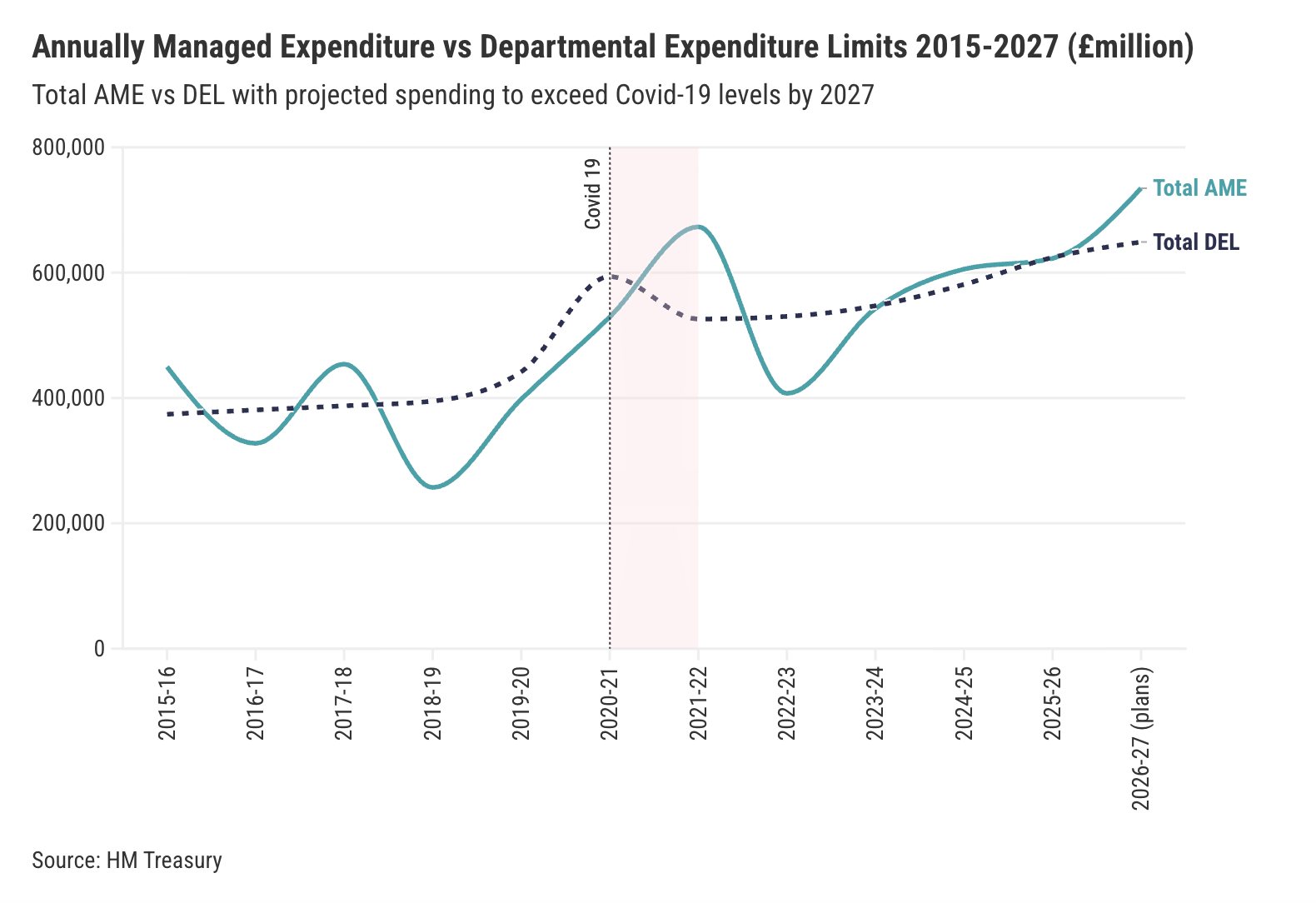
The headroom for departmental expenditures are determined by the requirements of AME, Three pressures stand out.
AME is increasing as a result of more welfare and disability payments, driven in part by greater claims of long-term illness and disability, particularly in the younger working age groups, most of which resulting from covid-related sickness.
Secondly, pensions are increasingly becoming a factor affecting government spending due to the triple lock introduced in 2010. The triple lock was designed to protect pensions and ensure they never fell behind the cost of living, to reduce pension poverty. Pensions are uprated each year by the highest of either inflation, 2.5% and the growth in earnings. This means that AME is guaranteed to increase each year, as the cost of living is only increasing.
The third is servicing the debt interest, and it feeds on the first two. Government expenditure is funded through borrowing or taxation. The trouble is more borrowing means a higher debt servicing cost, which pushes AME up again- a vicious cycle.
What does this mean for the Chancellor?
In principle, future DEL budgeting can absorb a rising AME bill, but in practice, this takes money away from unprotected departments but it would be politically difficult to cut welfare or pension payments. The Budget cannot reallocate DEL, which is fixed at Spending Reviews. Each increase in AME, manifests as a cut elsewhere, or as a call for higher taxation or borrowing. Its levers are tax, AME policy and the fiscal rules, and the room to use them is limited. Fiscal headroom has halved from £23.6bn in March to £11.3bn, with rising gilt yields the largest drag. Manifesto commitments protect around 70% of tax revenues, leaving wealth-based taxes, capital gains and sector-specific levies among the few viable options for raising revenue. Ultimately AME is increasing, and so the budget must reflect that with adjustments to taxation, so that the future DEL budgeting decisions are not compromised in the spending review.
