
Insights by Matthew Brighty, Senior Economist
Business groups from across the UK have set out their asks of John Healey ahead of this week’s Budget, and while their specific priorities differ, a common theme is very clear: costs are choking investment and stifling UK growth.
Given the tight fiscal constraints, businesses should not expect a major reprieve on Wednesday. But Healey has signalled that he wants to act. In an interview with The Times he pledged to cut the cost of doing business, and last week he announced plans that the Treasury says will save businesses up to £800m by cutting “pointless paperwork”.
Significant cuts to business rates or lower employer NICs are unlikely to happen at this Budget; there simply isn't the money for them. Tax stability and lighter regulation are different. They cost far less, which is precisely why Healey cannot afford to ignore them.
Expensive tastes
Energy, employment costs and business rates are where business is pressing hardest and where the headline asks are most expensive. NIC cuts, business rates relief and levies moved off energy costs would each be expensive, and with headroom tight, Healey cannot do too much on them at this Budget without having to make some very difficult choices elsewhere.
Energy costs
Energy costs dominate political debate. International energy prices are increasing with the war in the Middle East (the second energy crisis this decade) and UK policy and market structure mean that we see even higher costs than anyone else. It is no longer just energy-intensive sectors that bear the brunt, but businesses across the economy.
Businesses need access to energy at internationally competitive prices. Yet UK energy costs remain higher than those of many European peers, putting firms at a structural disadvantage.
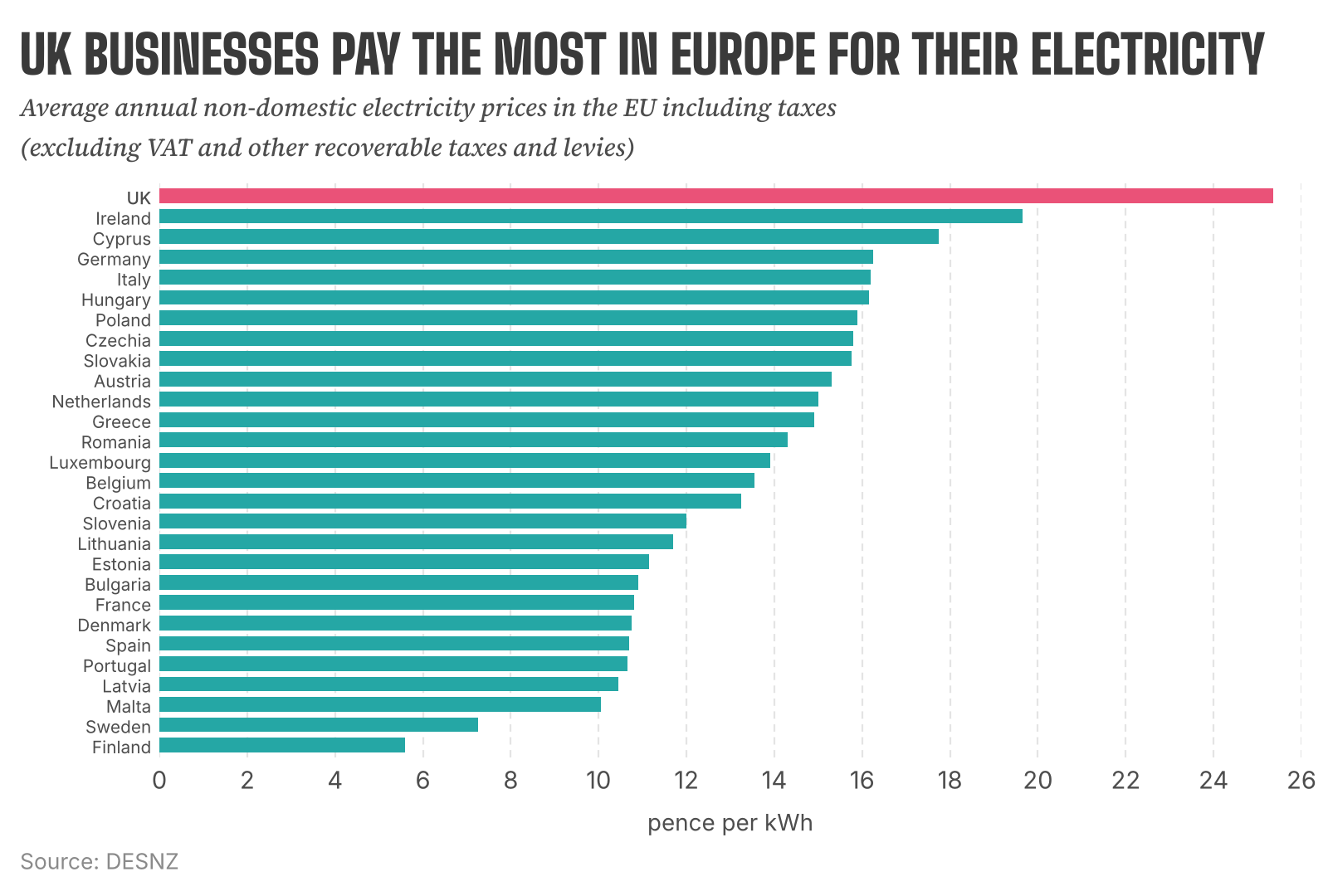
Businesses have called for lower energy costs and a rethink of how energy policy is funded. Make UK, the Confederation of British Industry (CBI) and techUK all want policy levies moved off non-domestic electricity bills, while the British Chambers of Commerce (BCC) has proposed that the government fund 75% of the Renewables Obligation for businesses.
Employment costs
Rising employment costs are a top priority for business. Trade bodies including the BCC, Make UK and the CBI have cited them as a key barrier to hiring and investment. The employer NICs increase in Rachel Reeves’ first Budget caused significant backlash
from business groups and since then business has also been hit by higher wage floors and even knottier employment regulation.
Businesses broadly agree that the cost of hiring needs to fall, but differ on how relief should be targeted. Make UK has suggested an increase in the employer NIC threshold to £7,500, while the BCC calls for a rate cut specifically for under-25s.
Business rates
Business rates penalise the very investment the government should be encouraging. Upgrading premises can raise a firm’s rates bill, and cliff edges in the system can make even small investments unviable.
The British Retail Consortium (BRC) has called for a freeze in CPI-linked increases, the removal of shops from the high-value multiplier and a gradual reduction in the overall burden. Make UK wants transitional relief for manufacturers raised to 100% in 2026/27, while UKHospitality has called for greater support for businesses hardest hit by the 2026 revaluation.
Cheap thrills
The cheaper asks are about certainty, not cash. Businesses want stable tax policy and relief from regulatory and compliance burdens, and neither would cost anywhere near as much as the headline asks.
Policy uncertainty is itself a business cost. Unpredictable changes to taxation and regulation add to existing costs and undermine firms' confidence to invest. Business groups want a competitive, predictable business environment. They argue that uncertainty, on top of rising costs and regulatory risk, further suppresses investment.
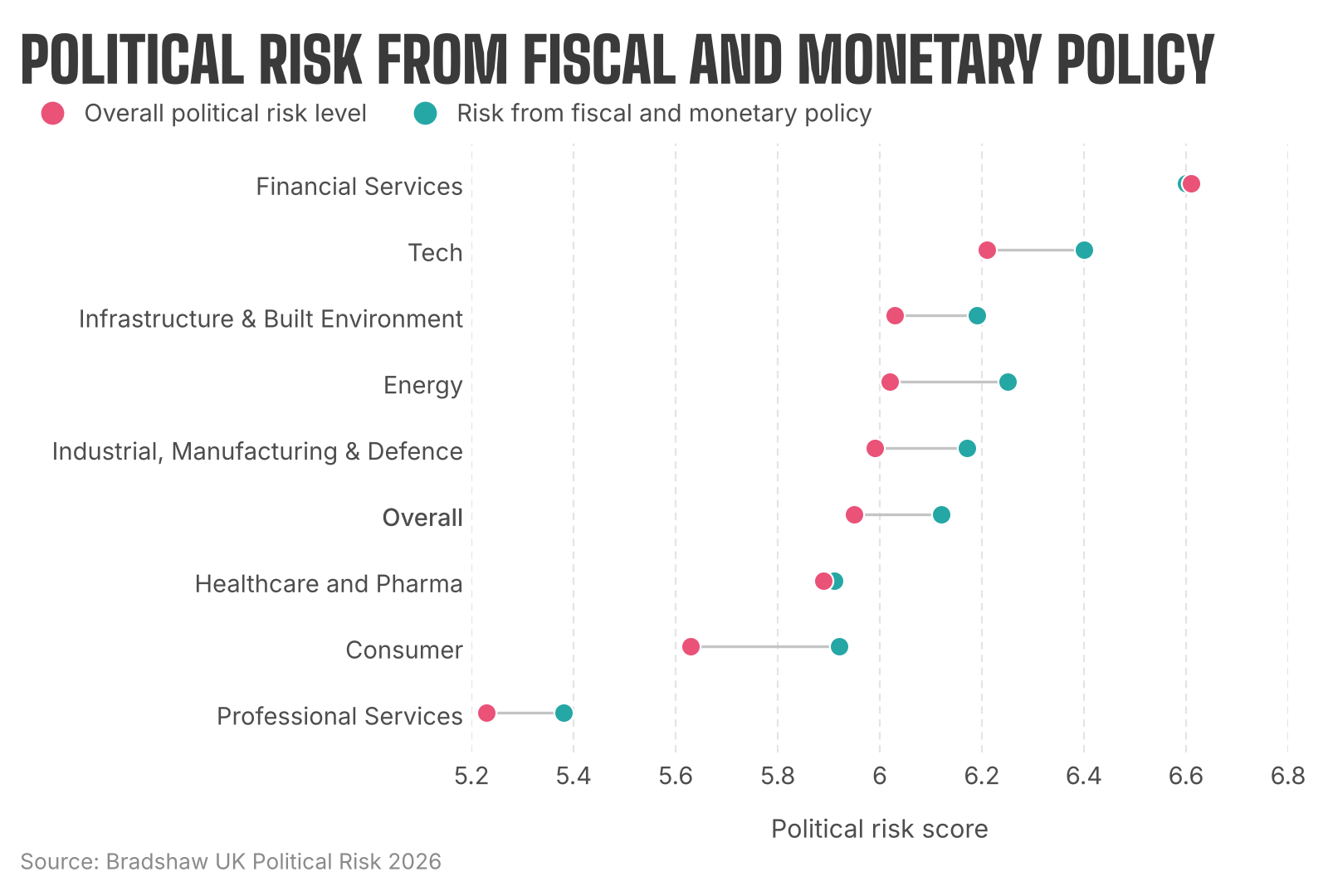
Polling for our 2026 political risk report showed why this matters. Some 64% of leaders surveyed said the way measures were trailed ahead of last year’s Budget created uncertainty for their business, while around a third reported material costs from policy changes and U-turns. Meanwhile, 87% do not expect the outlook for political risk to improve over this parliament. Financial services and tech were the two highest-scoring sectors in our political risk index. TechUK, UK Finance and TheCityUK are among those making the most explicit “do no harm” asks.
The CBI has highlighted the value of tax simplification as a growth policy in its own right. Complexity, uncertainty, duplicated information requests and fragmented HMRC processes absorb management time and delay business decisions. The National Audit Office estimates that businesses spend £15.4 billion a year complying with around 2,500 tax obligations. Simplifying the system could reduce this administrative burden, freeing up business resources for more productive activity.
The government has already moved in this direction. The Treasury says its changes to compliance guidance and reporting rules could save businesses up to £800m in administrative costs, and it has a target to cut regulation by 25% by the end of this parliament.
Read together, the Budget submissions make one request above all others: confidence that an investment decision made today will not be undermined by tomorrow’s policy changes.
What we want to see
Business costs are choking investment and stifling growth. This Budget may have little room for serious tax cuts, but tax stability and lower regulatory and compliance burdens are well within the Chancellor’s gift. Ruling out further sector-specific taxes, publishing a roadmap for major tax and regulation reforms and delivering on the cuts already announced would cost far less than the headline asks and would tell business that its costs are being taken seriously. The Budget will show whether business is a valued partner in the government’s growth ambitions or an afterthought in its plans.
We will be tracking business costs and Healey’s policies in our forthcoming Cost of Doing Business index. Keep an eye out for it in the coming weeks.
1. The Times (2026) John Healey pledges to cut the cost of doing business. Available at: https://www.thetimes.co.uk (Accessed: 26 October 2026).
2. HM Treasury (2026) Treasury plans to save businesses up to £800m by cutting pointless paperwork. London: HM Treasury.
3. Department for Energy Security and Net Zero (DESNZ) (2026) International industrial energy prices. London: DESNZ.
4. Make UK (2026) Autumn Budget Submission 2026. London: Make UK.
5. Confederation of British Industry (CBI) (2026) CBI Budget Representation 2026. London: CBI.
6. techUK (2026) techUK’s Budget Submission 2026. London: techUK.
7. British Chambers of Commerce (BCC) (2026) BCC Budget Submission 2026. London: BCC.
8. British Chambers of Commerce (BCC) (2026) Business Priorities for the Budget. London: BCC.
9. HM Treasury (2024) Autumn Budget 2024. London: HM Treasury.
10. Make UK (2026) Employment Costs and Competitiveness Report. London: Make UK.
11. British Chambers of Commerce (BCC) (2026) Youth Employment & NIC Relief Proposal. London: BCC.
12. Valuation Office Agency (VOA) (2026) Business Rates Impact Assessment. London: VOA.
13. British Retail Consortium (BRC) (2026) BRC Budget Submission 2026. London: BRC.
14. Make UK (2026) Transitional Relief for Manufacturers. London: Make UK.
15. UKHospitality (2026) Revaluation Support Request 2026. London: UKHospitality.
16. Confederation of British Industry (CBI) (2026) Policy Uncertainty and Investment. London: CBI.
17. Bradshaw Advisory (2026) Bradshaw UK Political Risk 2026 Index. London: Bradshaw Advisory.
18. TheCityUK, techUK and UK Finance (2026) Joint Financial and Tech Sector Budget Priorities. London: TheCityUK.
19. National Audit Office (NAO) (2025) The Cost of Tax Compliance for Businesses. London: NAO.
20. HM Treasury (2026) Better Regulation and Compliance Target Update. London: HM Treasury.
