
At the end of September, Prime Minister Andy Burnham announced plans to reform the triple lock from April 2030, keeping protection against inflation and a 2.5% minimum increase while removing the ratchet that allows earnings catch-up to compound over time. Using successive OBR forecast vintages, this article explores why reform can look politically unattractive over the short term even as the costs of leaving the system unchanged build over time.
In March 2021, the Office for Budget Responsibility forecast the State Pension to cost £123.1 billion in 2024-25. It ended up costing £138.0 billion, nearly £15 billion more than forecast. Most of that miss would have happened under any uprating rule: inflation and wages both jumped, and any pension linked to either would have followed them upwards.
A key part of how the State Pension works isn’t so much each individual increase but the cumulative impact year after year as all economic shocks get baked in. Each April's rise is the highest of earnings, prices and 2.5%, so a one-off spike becomes the base for every later increase.
That is why the Institute for Fiscal Studies’ latest figures show that state pension spending this year is around £16 billion a year higher than it would have been if pensions had risen with earnings since 2010.
This £16 billion figure is only the annual premium against an alternative policy. It’s not the sum of everything spent since 2010, nor is it a £16 billion OBR forecasting error. Keeping those distinctions clear is essential to understanding both the context and the choices now facing government.
It shows how a promise that can look relatively inexpensive over a relatively short horizon, such as the lifetime of a Parliament, becomes a substantial and growing commitment longer term.
How the ratchet works
The inflation figure is the previous September's CPI, and the earnings figure is annual growth in average total earnings over May to July. The pension then rises by whichever of those two is higher, or 2.5% if both are lower.
Start with a pension of £100. In year one, prices rise 10% and earnings 5%, so the pension rises to £110. In year two, earnings rise 8% and prices 3%, so it rises again, to £118.80. A pension linked to earnings throughout would have reached £113.40. One linked to prices would have reached £113.30.
Over the two years, prices and earnings grew by almost exactly the same amount, yet the triple-locked pension grew faster than either. If both systems then rise at the same rate, the percentage gap stays, and its cash value grows with it. It also applies to the rate paid to future pensioners, so it doesn't disappear when today's recipients do.
The 2.5% floor creates an additional route to a higher pension level when both inflation and earnings growth are low, say during a recession.
Weak earnings as well as high inflation
Below you can see which of the three elements has done the work in which year in setting the increases in the State Pension. There is just one exception. In April 2022 the earnings element was suspended, because the pandemic had distorted annual earnings growth. Pensions rose 3.1% instead of 8.4%.
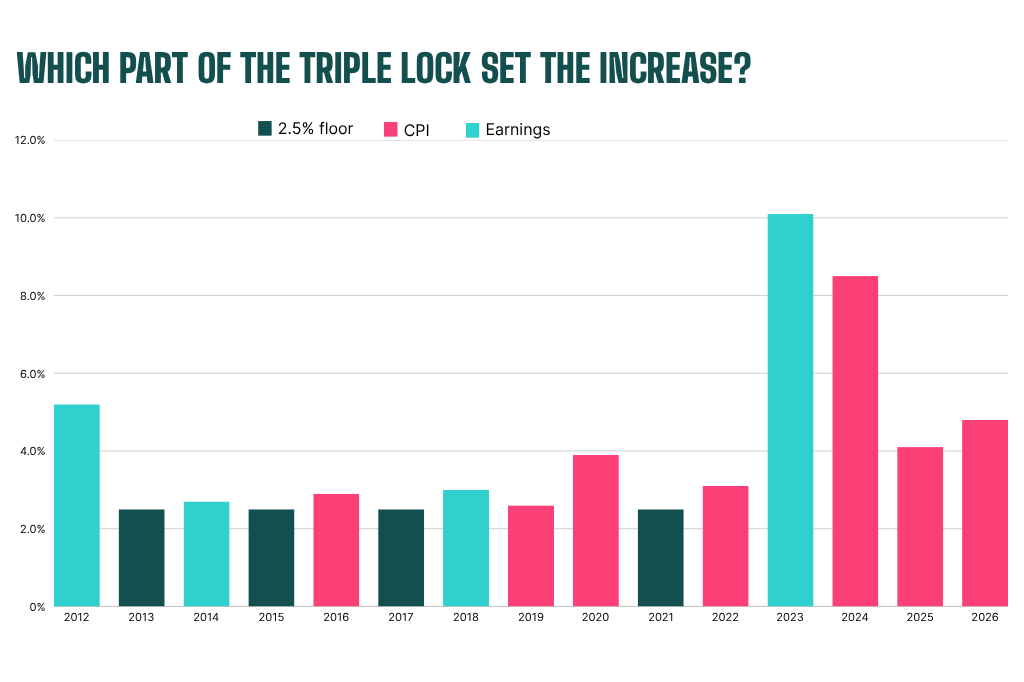
The recent shocks have produced much larger rises: 10.1% in April 2023, then 8.5% in April 2024. Together those raised the pension rate by 19.5%.
Protecting pensioners during an inflation shock has an obvious purpose, because many can't raise their earnings when bills rise. But when workers then negotiate pay rises to catch up with prices, the triple lock adds those rises on top of the inflation protection already given.
What the forecasts expected
I compared 22 OBR spending forecast vintages, from March 2015 to March 2026, with the outturns reported later. The chart below illustrates how forecasts have changed over that period, mostly showing that in the early 2010s, it didn’t deviate too far but then economic shocks from the Ukraine war and the pandemic took hold. I like to think of this chart as the reverse of the UK productivity forecast for anyone who’s familiar with that.
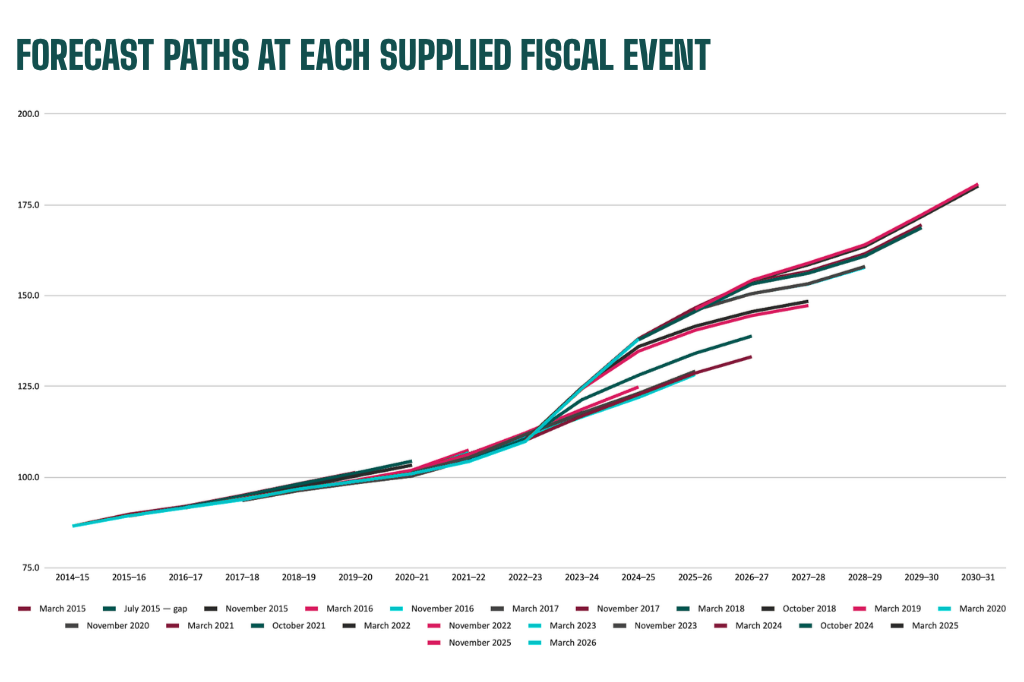
I mentioned the year 2024-25 earlier. Just as an example, the March 2020 forecast for 2024-25 was £124.8 billion, and March 2021 it was a bit lower at £123.1 billion. Then it climbed: £128.1 billion in March 2022, £134.7 billion in March 2023 and £137.9 billion by November 2023, close to the £138.0 billion outturn.
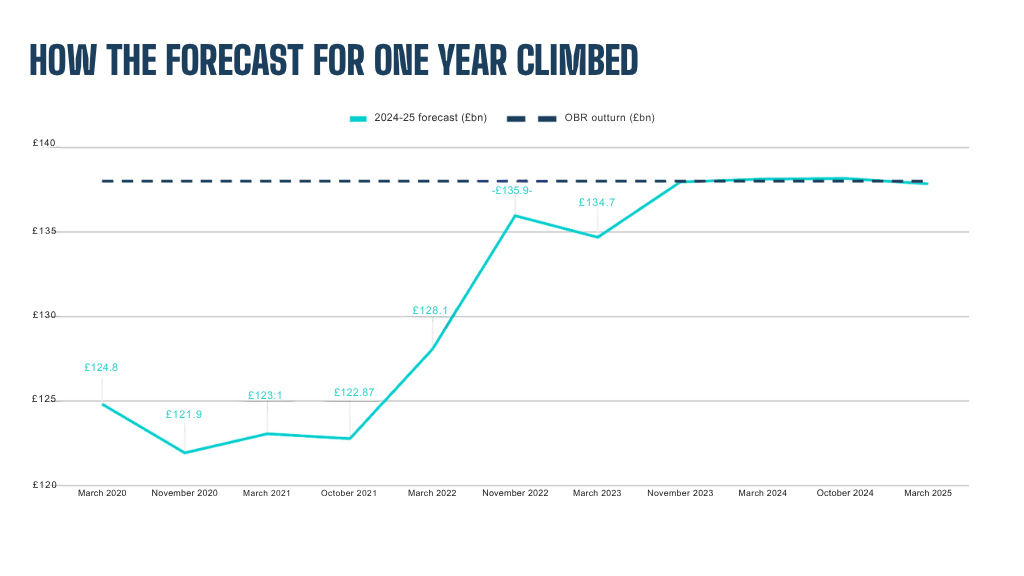
The uprating assumptions explain why. In March 2021, the OBR expected increases of 2.7% in April 2023 and 2.5% in April 2024. By March 2022 these had become 7.5% and 3.4%. The outturns were 10.1% and 8.5%. Inflation lifted the pension first, and then strong earnings lifted it again.
Total spending errors like these include caseload, policy and statistical changes but as well as economic shocks, so it’s not all down to the triple lock, but the vast majority is.
Reform should start with a clear objective
Last week, the Prime Minister announced a redesigned triple lock to take effect from 2030-31, which the IFS describes as a major and welcome change. As they describe it, the new system keeps inflation protection and the 2.5% minimum but links the pension to earnings over the long run. Its aim is to stop earnings catch-up being added on top of an earlier inflation rise.
That feels like a step in the right direction. Dropping only the 2.5% floor would leave the inflation-then-earnings ratchet intact, as would an inflation and earnings double lock. A pure earnings link would remove it, but likely exposes pensioners to real losses when prices outrun wages.
What it saves, and why nobody knows
Labour says the reform will save £15 billion a year by 2039-40, rising to £50 billion a year by 2050. The IFS is more cautious about the size of the savings and I would hope most of you are too if you’ve made it this far down the article:
Part of the £15 billion is inflation. In today's terms it is about £11 billion, and the IFS says it could reasonably be anywhere between £4 billion and £20 billion.
The range is wide because the old rule was too unpredictable to cost with confidence, which is the problem the reform addresses.
Savings should be small at first and build over time. Had the new policy applied since 2011, spending this year would be £9 billion lower, more than halving the £16 billion premium.
The savings also have limits. The IFS says they can't fund universal social care on their own, so tax rises or spending cuts will almost certainly still be needed.
Why it took this long
Those numbers also explain why reform was so hard to start. In any five-year forecast window the triple lock looks cheap because of how the OBR forecasting works. So right now, the IFS notes that current OBR forecasts add only a further £600 million a year by 2029–30 on top of an earnings baseline, because the OBR’s model always reverts back to long-term average rises for inflation and earnings. £600m isn’t much but from recent experience we know it’s unlikely to be just £600m more.
If recent experience has shown us anything, it is that the world is a volatile place and that’s unlikely to change. So while we don’t know what the next shock is, it’s likely to push up pensions further if we keep the triple lock. The triple lock was costed for a relatively calm economy we’re paying for it during a volatile one.
[1] IFS, What do you need to know about the triple lock, updated 15 September 2026.
[2] House of Commons Library, State Pension triple lock, historical uprating table, PDF pages 17–18.
[3] IFS, How will the new triple lock work and what effects will it have, 29 September 2026.
