
Matt Latham on the fragmentation of our electoral system.
What has changed since May
After the May local elections I asked whether the two-party system was finished. My answer was that it was finished as a description of how people vote. As a description of how Westminster works, it hadn’t yet been tested. The results were the first hard evidence beyond the polls that support for the two main parties was receding fast.
A lot has happened since then. Andy Burnham is Prime Minister, the sixth since 2016. Labour has recovered some ground in the polls. Reform has been hit by scandals and its numbers have started to slip. In his conference speech, Burnham all but committed Labour to changing the voting system.
Labour’s recovery in the polls is the main thing that could change that picture. If it continued to the point where one party could plausibly win a majority on its own, the classic two-party system would start to look more stable. That would be evidence that first past the post can still deliver stable governments. The latest polling suggests Labour is still some way from that point.
What the MRPs show
Over the past few weeks, YouGov and Survation have both published large-sample MRP polls and both point to gridlock. YouGov’s central estimate puts Labour on 241 seats, 85 short of a majority, with the Conservatives on 130 and Reform on 123. YouGov’s own reading is that Labour would probably need at least two other parties to govern.
YouGov’s projection comes with a margin of error for every party in every seat. I used those margins to run 4,000 simulated elections, to see how far the result could plausibly move from the central estimate. The simulations give the same seat ranges as YouGov’s own published figures.
In the simulations, Labour reaches a majority in fewer than 1 in 100 runs and its strongest plausible result is around 280 seats. Labour and the Lib Dems together have a majority in about a quarter of runs. Adding the SNP takes that to more than four in five. On the poll as it stands, the most likely majority needs three parties.
To see how much opinion would need to move, I shifted vote share between parties in every seat and re-ran the simulations. The table shows the shift at which each outcome becomes more likely than not.
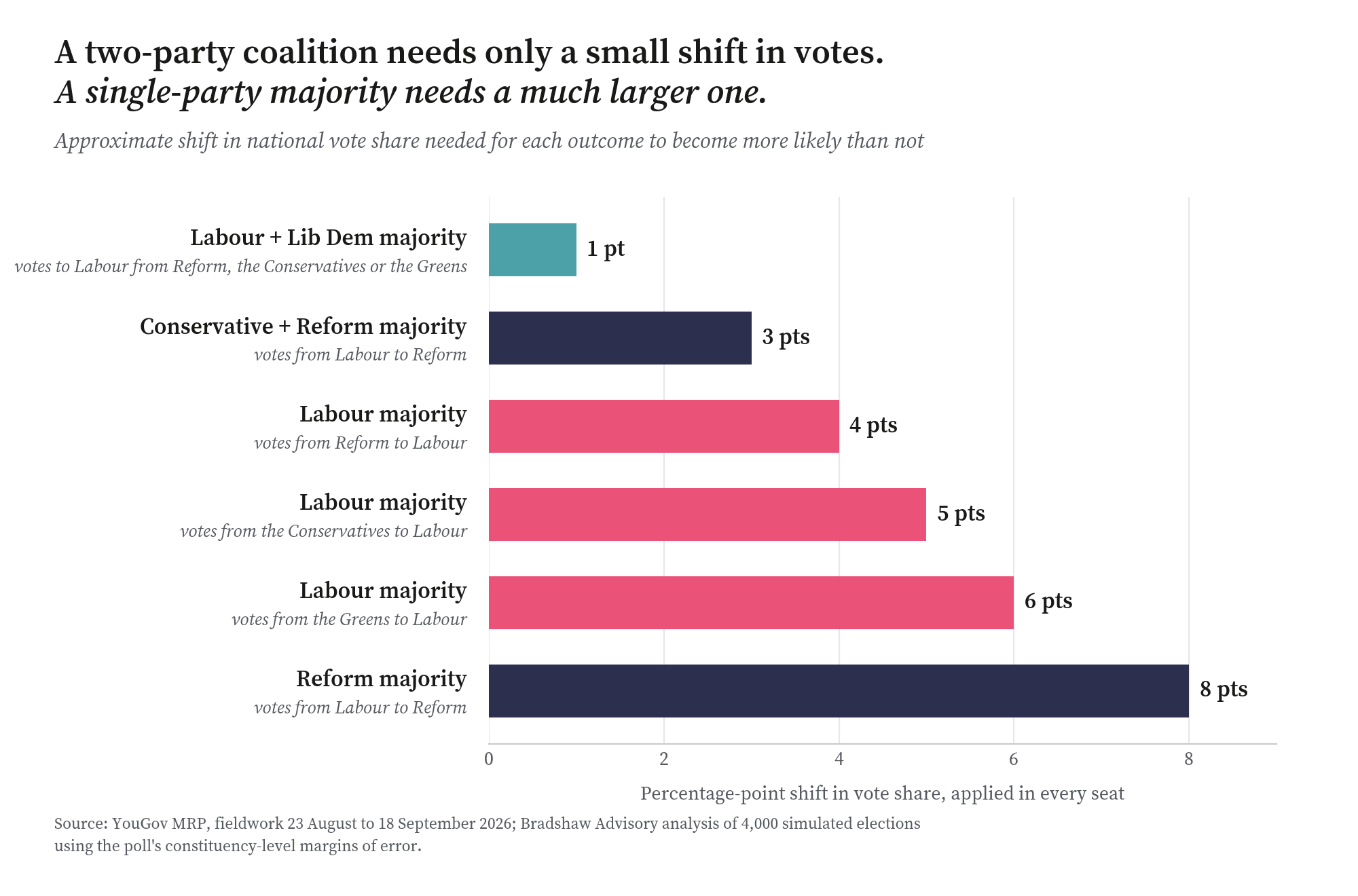
The two-party coalition is closer than the headlines suggest, since a one-point shift is within normal polling error. A single-party majority is much further away. Labour would need to take four points from Reform to have an even chance, starting from a position where it is already the largest party. Reform governing alone would need around eight points from Labour.
On current numbers, the realistic outcomes are a two-party or a three-party government. A single-party majority, usually cited as the main advantage of first past the post, would need a large shift in opinion.
Why that matters
First past the post is very good at producing two-party systems. Only the winner in each seat gets anything, so over time voters drift towards the two parties that can actually win and everyone else gets squeezed. Political scientists call this Duverger’s law. It is a large part of why every government since 1945 has been led by either Labour or the Conservatives.
If a system designed to produce two dominant parties no longer does so, fragmentation has gone far enough that those pressures have stopped working.
The main argument for first past the post is that it produces clear, accountable government, at the cost of under-representing smaller parties. If it stops producing clear governments, that argument is much weaker. After six prime ministers in ten years, an inconclusive election is likely to reduce confidence in the system further.
What could replace it?
In his conference speech, Burnham said: “We will contest the next election with a manifesto commitment to change the electoral system, so that everyone’s vote counts and everyone’s voice is heard.” He went further and announced a National Commission on Electoral Reform, inviting all the parties to take part in its work.
Burnham has argued for this before. At a rally at the same conference last year he said that “PR’s time has come”, adding: “We can’t succeed in the eyes of the world if we continue with the levels of political turbulence we have seen in recent times.”
The main thing reform should achieve is legitimacy. In 2024 Labour won 411 of 650 seats on about 34% of the vote. A government elected on that basis has a strong mandate in Parliament but a weak claim to popular support, which makes it harder to take decisions with confidence and easier for opponents to challenge them. This is the long-term problem reform should address.
There are also two more immediate issues. The first is stability: there have been six prime ministers in ten years. A more legitimate system might help, although most of that turnover happened within single-party governments, rather than as a result of the voting system.
The second is whether a government can be formed at all. On current polling, the next election could well produce gridlock, with three parties needing to come together to form a government. That brings real coordination problems, since three parties have to agree a programme and then hold together through difficult votes. If this becomes a lasting feature of UK politics rather than a one-off, those coordination problems would make it very hard to govern.
The Alternative Vote keeps single-member seats and lets voters rank candidates. It was rejected by about two to one in the 2011 referendum. Because it is not proportional, a party could still win a large majority of seats on a minority of first-preference votes. It would therefore do little to address the legitimacy problem. In a fragmented field it would favour the party most voters accept as a second choice. That could produce majorities more often than first past the post does now, but the outcome would depend on how votes transfer between parties, which is hard to predict.
Proportional systems, which Burnham has said he favours, would make seat shares match vote shares, which addresses legitimacy directly. They would not make governments easier to form; coalitions would become the norm. Parties would go into elections expecting to negotiate and there would be an established process for forming a government, whereas under first past the post a hung parliament is treated as a failure. Experience elsewhere varies. Germany and the Nordic countries have had stable coalitions for decades, while Belgium went 541 days without a government in 2010 and 2011.
PR would deal with the legitimacy problem and make coalition-building a normal part of politics, but negotiations over who governs would remain.
What happens next
Nothing has been decided yet. Any change will come after the next election and much of the work falls to a commission that has not yet been set up. The next election will be fought under first past the post. For now, electoral reform is a promise rather than a change to the rules. On the evidence of the MRPs, that election looks set to be very fraught. A hung parliament is the most likely result. Small movements in the vote could produce very different outcomes. Forming a government could take three parties. That points to at least as much uncertainty and instability as we have seen in recent years, if not more. Whatever the commission eventually recommends will only take effect after the current system has been through that test.
First past the post now looks unreliable as a way of producing governments, but no alternative will be in place soon. Burnham’s speech is further evidence that the Labour-Conservative duopoly is weakening, rather than the point at which it ends.
If current trends continue, we should expect more gridlock before anything changes.
