
Is the two party system finished?
Economist Matthew Latham looks at what the May 2026 local election results tell us about the shape of British politics to come.
A few weeks have passed since the May local elections, long enough for the immediate noise to settle, but nowhere near long enough for the questions the results raised to die down.
The first-night coverage gave us the news that Reform swept northern England, Labour clung on for dear life, the Lib Dems quietly extended their gains in the South and the Greens made some serious progress in urban centres.
The more important question, what these results tell us about the long-term structural health of British two-party politics, deserves more careful treatment than the news cycle allowed. Here I’ve taken a look at the data and simply asked - is the two party system finished (at least for the time being)?
The short version: as a description of how British people vote, the two-party system looks dead. As a description of how Westminster works, there’s still a lag, given the system hasn’t had a proper test since 2024. But, as you’ll see below, the shape of the local election results indeed suggest that ‘this time it’s different,’ with genuine multi-party competition emerging that a) we cannot dismiss as ‘protest votes’ and b) will lead to a seriously different landscape at a general election if it persists.
What happened?
Before using the results, we need to acknowledge what they are and are not. Local elections consistently produce lower turnout than general elections (roughly 30-35% vs 60%+) and voters use them differently. The main parties’ supporters are more likely to stay at home, voters with grievances are more likely to turn out. This means Labour and the Conservatives always do worse at locals than at GEs, and challenger parties always do better. Any comparison between local and national figures has to carry that caveat.
A second caveat on the sample matters more than the headline demographic figures suggest. As the New Statesman noted ahead of polling day, English local elections “take place somewhere every year, but not in a way that offers a fully representative national snapshot.”
The specific issue in 2026 is that all 32 London boroughs voted, alongside all 32 metropolitan boroughs. London alone accounts for roughly a quarter of the councils in the sample and votes very differently from the rest of England. Labour and the Greens perform significantly better in London; Reform significantly worse.
The sample skews younger and more educated primarily because of London’s weight within it, not as a general reflection of the areas voting. Outside London, Reform’s share in these elections would be materially higher and the Greens’ materially lower. The national headline figures are, if anything, a conservative reading of how Reform stands across England as a whole.
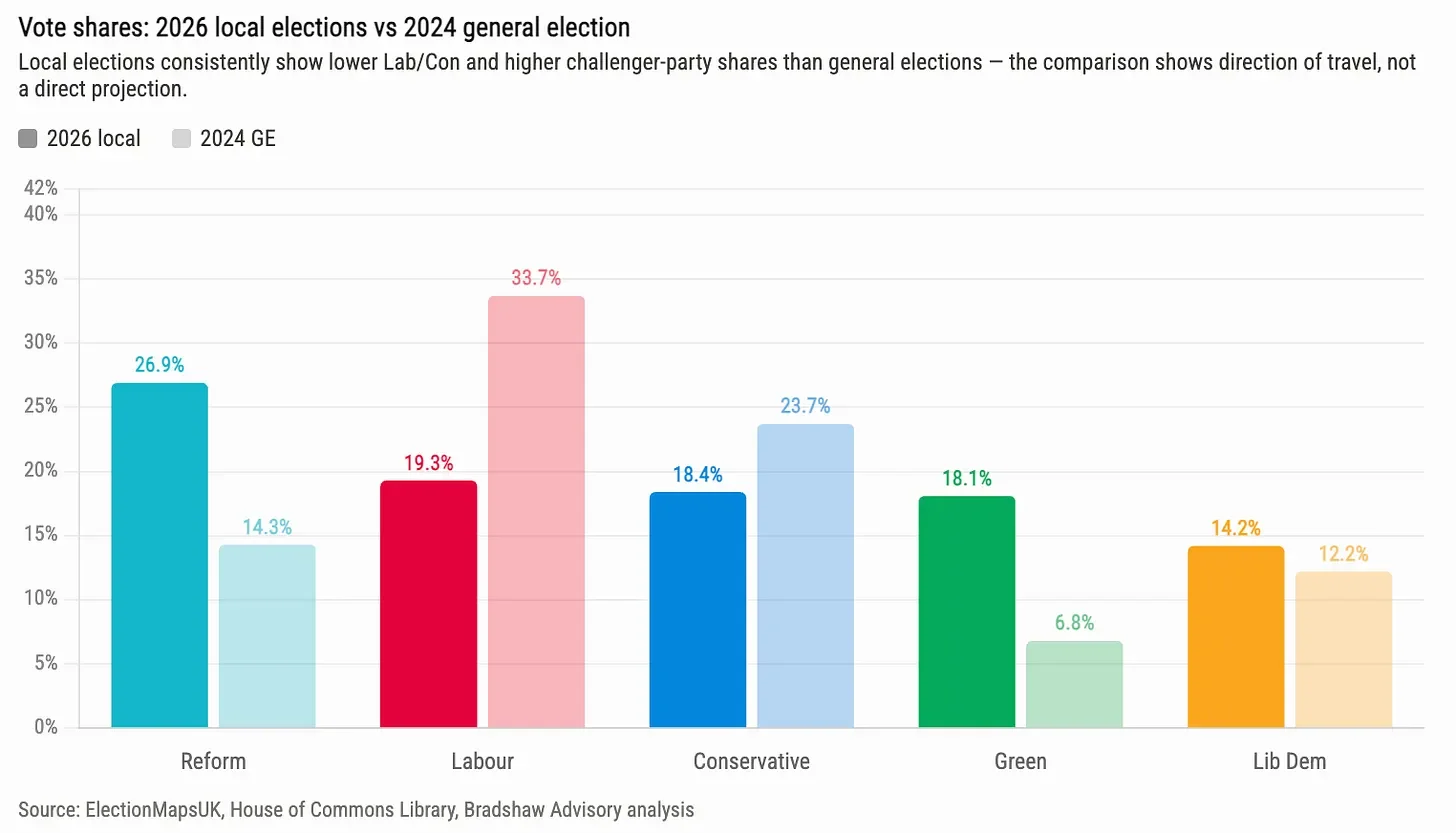
With those points in mind, the basic picture:
Why the usual explanation doesn’t hold
The standard response to these kinds of local results is “protest vote.” Voters vent mid-term, smaller parties overshoot their genuine support, and the main parties recover at the general election. For UKIP in 2013-14, this diagnosis was broadly correct: UKIP reached 28% in local elections while Westminster polling had them at around 10-12%. Their local share vastly exceeded what voters actually intended at a general election. After 2015, the analysis looked prescient.
Reform is not UKIP. May’s local results put Reform at 27%. Current Westminster voting intention polls average 27.7% for Reform across the major pollsters. There is essentially no gap between their local performance and what voters tell pollsters they intend to do at a general election. The protest premium does not exist this time.
That makes the historical trend in Labour and Conservative combined vote share at general elections the right frame for assessing what is happening:
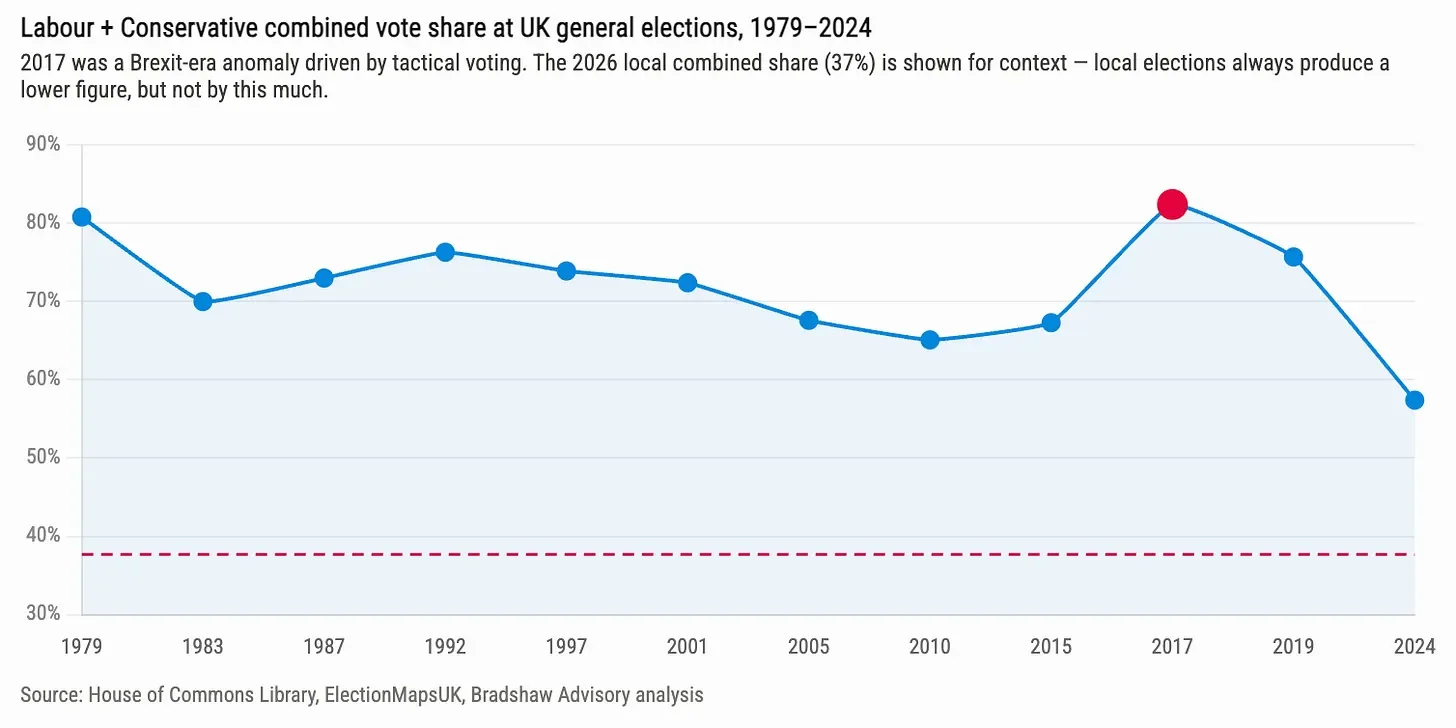
The long-run decline in combined Labour-Conservative GE vote share has been real but gradual, interrupted by 2017, when Brexit-era tactical voting temporarily squeezed the field back to 82%. The 2024 result at 57% marked the sharpest single-election drop in that share since the 1970s. The 2026 local combined share of 37% sits well below any previous local election low (the previous floor was 55% in 2013 at UKIP’s peak). Local elections always produce a lower combined share than GEs, but not by this much, and not consistently with Westminster polling showing the same picture.
The real question is what it would take for that trend to reverse at the next general election. For Labour and the Conservatives to recover to even their 2024 combined level of 57%, Reform and the Greens would need to fall collectively from 45% to around 28%. That is possible, but it requires a scale of tactical return to the main parties for which there is currently no evidence.
Where Reform and the Greens are winning
The fragmentation is not geographically random and the pattern across councils is directly relevant to the two-party question.
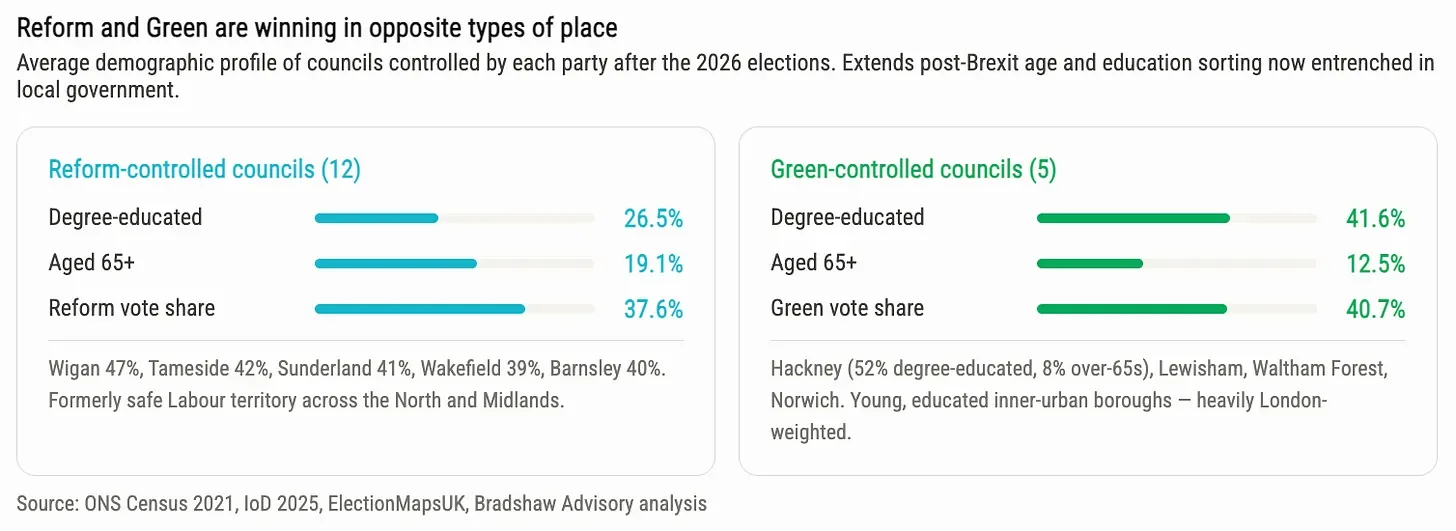
Reform is winning in post-industrial towns across the North and Midlands, places that voted heavily for Brexit and used to return Labour MPs automatically. The Greens are winning in younger, urban boroughs where Labour still dominates at Westminster but is visibly losing its grip at council level.
These patterns will be no surprise to anyone, they both extend trends easily visible since 2016 (and earlier). What is new is that these parties are now translating those voting patterns into actual local administrations. With that, they are building the candidate pipelines, local profiles and organisational infrastructure that general election campaigns require.
Why vote efficiency under FPTP determines whether any of this reaches Westminster
Under first-past-the-post, winning seats requires votes to be concentrated enough to reach the top in individual contests, but spread widely enough to reach the top in many of them. The Greens pile up large margins in Hackney and Bristol but trail badly almost everywhere else, which is why 18% of votes produces only 12% of seats.
Reform’s 27% reaches 35-45% in specific northern constituencies while remaining competitive across a much wider range of areas, which is why 27% of votes produces 29% of seats.
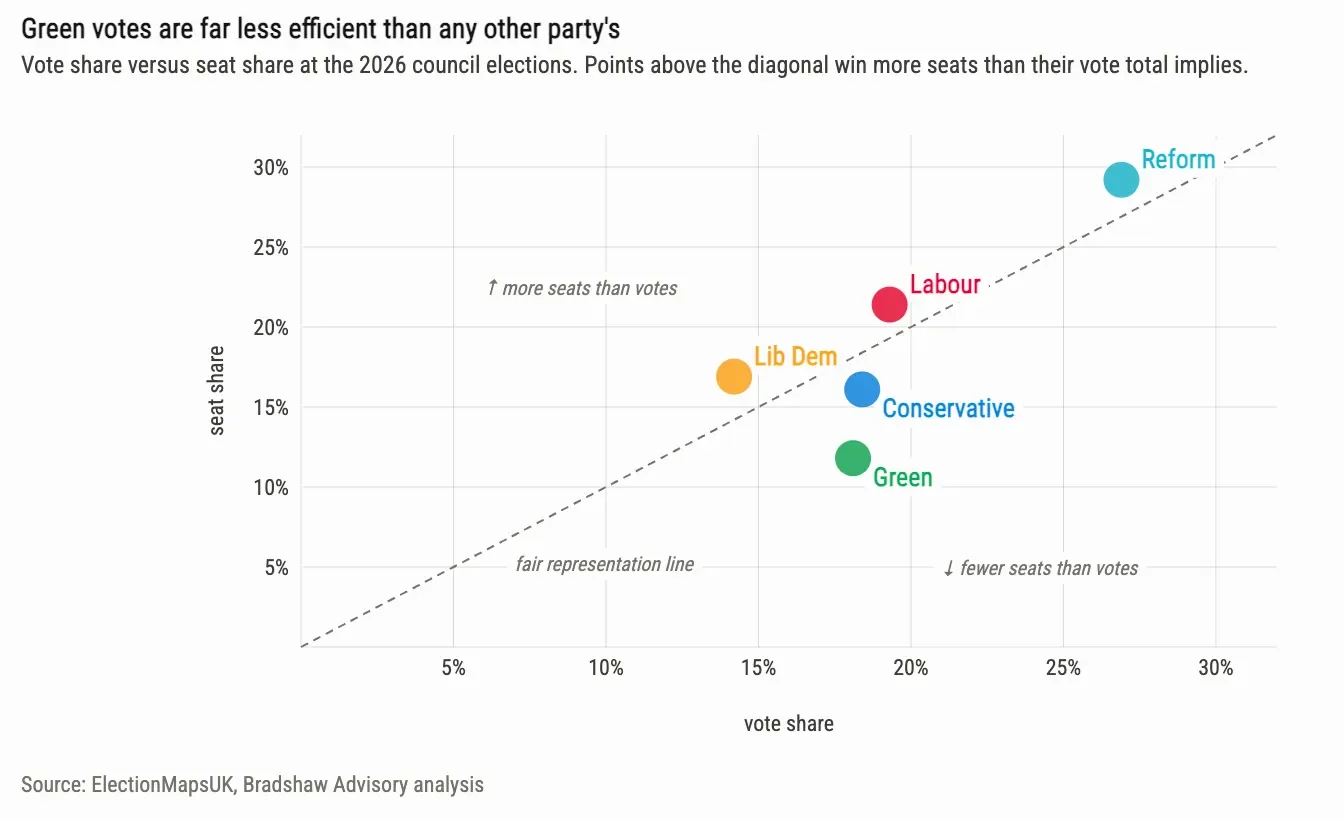
This distinction is the central question for whether fragmentation translates into parliamentary change. Reform is already converting votes into seats more efficiently than the Greens, and that efficiency is improving as it builds concentrated local bases. If it continues to track at current polling levels into the next general election, the arithmetic for 50-100 Reform Westminster seats is not implausible.
The new battlegrounds
Three distinct contest types are emerging to replace what used to be a simpler two-party map.
The first is Labour versus Reform across the North, where the Conservatives have become an irrelevant third party and the fight is now a direct replacement for the old two-party contest, just with different protagonists. The Makerfield by-election is the first live test: Reform swept every ward in that constituency last month at around 50% against Labour’s 24% and Labour’s response has been to field Andy Burnham, whose personal vote is the argument (not the party’s underlying local strength).
The second is Labour versus the Greens in progressive urban seats, where Green local bases are creating a slower-building but real Westminster threat. In Bristol East, the Greens took 31% of the vote in 2024 against Kerry McCarthy’s 45%. A 7-point further swing to the Greens would flip the seat. In London, Hackney, Lewisham and Waltham Forest now have Green councils within boroughs containing safe-looking Labour Westminster seats. Those are the next stage of the same trajectory, running one electoral cycle behind Bristol.
The third type is less visible but potentially the most disruptive: a growing number of seats where three or four parties are genuinely competitive and small vote-share shifts produce large and counterintuitive outcomes under FPTP. In several Labour-held marginals in Lancashire and East Anglia (e.g. Hyndburn, Lowestoft, Norfolk South West) Labour leads the Conservatives by around 5 points with Reform close behind. In those seats, a further shift from Labour to Reform would actually end up handing the seats to the Conservatives. The party that gains votes does not gain the seat, but the party that held it still loses one. As more of the electoral map falls into this kind of multi-party instability, national swing figures become an increasingly unreliable guide to what the actual seat count will look like.
Is the two-party system finished?
As a description of how British people vote, the two-party system is over. Labour and the Conservatives combined polled 37% in May and sit at 36% in current polls, the lowest combined share in any comparable measurement. Reform is dominant in the North; the Greens are building in younger urban boroughs. It reflects where voters have been moving since 2016 and it is accelerating.
The parliamentary two-party system has not yet collapsed, but it has not been tested since 2024. A great deal has changed since then.
Labour’s 2024 landslide rested on a specific combination: an anti-Conservative tactical vote, Reform splitting the right before it had genuine local presence, and Labour winning scores of seats on thin pluralities of 30-35%.
The reverse is happening now, with Labour polling at around 17-18%. Reform is winning the very councils containing the seats Labour won most narrowly. For FPTP to deliver another disproportionate Labour majority, you would need Labour to recover 15 points nationally while Reform simultaneously fails to consolidate in the northern seats it has just taken at council level. That requires a lot to go right for Labour at once - which does not look at all likely.
Reform has five Westminster MPs, 1,400 councillors and is running council administrations across northern England. It is not UKIP. The Makerfield by-election in June, fought in a constituency where Reform just won every ward at 50%, is the first real test of whether that organisation holds under general election conditions. The two-party system at Westminster may yet survive, but I’m not sure that I would count on it.
