
The government’s announcement this week of Your First Home as an equity loan scheme brought back memories of working on Help to Buy at HM Treasury in the early 2010s, and later hearing how it was shaping the market while I was at the Council of Mortgage Lenders (CML).
It also brought to mind a mug my old boss at the CML had given me, complete with a chart of mortgage lending to first-time buyers. An economist’s gift, admittedly, but one that still captures an important lesson for the new policy.
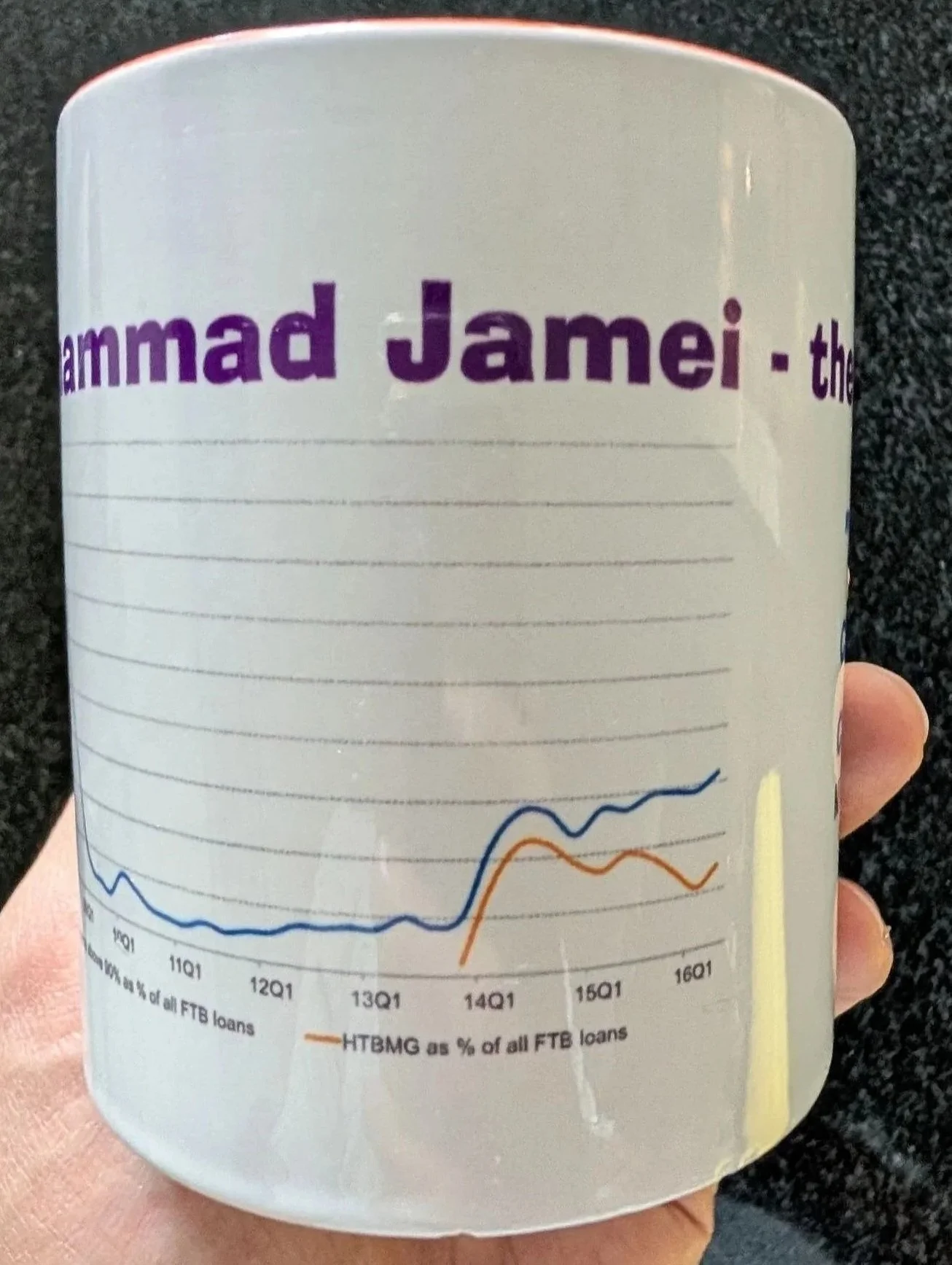
An economist’s gift from my former boss at the CML. Blue: lending above 90% loan-to-value as a share of first-time-buyer loans. Orange: Help to Buy: mortgage guarantee lending as a share of first-time-buyer loans.
At the Treasury, I worked on modelling the mortgage guarantee, including the fees we charged lenders and the scheme’s expected costs and claims. The aim was to ensure it was designed to be cost neutral and complied with EU state aid rules so we weren’t inadvertently providing lenders with a subsidy.
The chart on the mug illustrates what came next.
High loan-to-value lending to first-time buyers had collapsed after the financial crisis. It subsequently recovered, while lending through the guarantee scheme rose initially and then became a smaller part of the picture. For me, that was a key measure of success: the market increasingly providing mortgages to people with small deposits without needing the government guarantee.
After moving to the CML (now UK Finance) a few years later, I saw how the separate equity loan scheme had become something housebuilders were increasingly accustomed to and hence much harder to withdraw.
Those experiences leave me cautiously supportive of the new policy. There is a role for the government in helping creditworthy households overcome barriers to homeownership. But we should take the lessons from the previous schemes seriously, including how we measure success, how borrowers understand their commitments and how support eventually ends.
Help to Buy was several different policies
The shared branding sometimes obscured important differences.
The mortgage guarantee, launched in 2013, helped lenders offer mortgages to buyers with small deposits. Banks paid the government for protection against a portion of potential losses. The buyer remained responsible for the mortgage. It covered both existing properties as well as new builds.
The equity loan, launched in England also in 2013, supported purchases of new-build homes. Buyers would generally have to put down a 5% deposit, the government provided an equity loan of up to 20%, and a mortgage covered the rest. Given the price differentials in London, the maximum equity loan was increased to 40% in 2016. The scheme was subsequently narrowed to first-time buyers, with regional price caps, before closing in 2023, a full decade after it was announced.
Then there was the Help to Buy ISA, introduced in December 2015, which helped people save towards buying their first home through a 25% government top up, capped at £3,000. It closed to new accounts in 2019, although existing account holders can continue saving until 2029 and claim their bonus until 2030.
Each addressed a different part of the problem: mortgage availability, the financing of a purchase, or saving for a deposit. They should be judged accordingly although I won’t cover the ISA here.
The mortgage guarantee was addressing a clear problem and had a test of success
In the aftermath of the financial crisis, the availability of mortgages for people with small deposits was a big issue as house prices were falling and banks were risk averse. In a falling market, having a 95% (or in those days 100%) loan-to-value (LTV) ratio mortgage would mean it doesn’t take much for the size of the mortgage to be bigger than the value of the house. Added to which the economy wasn’t in a great place meant that lenders had, understandably, retreated to lower LTV mortgages. The mortgage guarantee was intended to help restore that market.
Its financial design mattered to ensure we complied with EU state aid rules. Lenders paid a commercial fee intended to cover expected losses, administration and the cost of capital. The scheme was designed to pay for itself, with participating lenders paying for the protection they received.
There was also a reasonably clear way to recognise success: lenders offering high loan-to-value mortgages without needing the guarantee.
By the time closure was announced, more than 30 lenders were offering mortgages at 90-95% loan-to-value independently of the scheme. It closed to new applications at the end of 2016.
My assessment is that withdrawing it worked well (and not just because I had a hand in the scheme). The market could continue providing those mortgages without the original intervention and so the identified problem at the outset was resolved. That is an important form of policy success: the government helping a market recover sufficiently to step back.
The equity loan became harder to leave behind
The equity loan followed a different path. It ran for a decade, with extensions along the way.
At the CML, I would often hear that housebuilders had become accustomed to its availability and assumed it would continue, in some cases indefinitely. It had become part of the market they planned around. In my view, there was no comparably firm commitment to withdrawal, or clear agreement about the conditions under which support would no longer be needed.
There was also a difference in incentives. Lenders paid to participate in the mortgage guarantee. The equity loan had no equivalent developer fee for access to the support.
None of this means the equity loan failed to deliver benefits. The independent evaluation published this month found additional housing supply and estimated £25.1 billion in net present social value. That figure is a modelled lifetime benefit, driven largely by the value of additional development and incorporating projected loan repayments. It is not a Treasury cash profit. The evaluation also found stronger supply effects earlier in the scheme as well as some upward pressure on prices in some areas of the country where prices were already elevated.
The lesson is that an intervention can deliver benefits while becoming difficult to withdraw. Evidence that a policy worked when introduced does not automatically establish the case for each subsequent extension.
Understanding the loan mattered too
Another concern was how borrowers understood their commitment.
The initial offer was attractive: a smaller deposit, a smaller mortgage and no interest on the equity loan for five years. Mortgages are well understood but the equity loan scheme was not, nor were the repayment mechanics.
Under the original scheme, a 20% equity loan generally meant repaying 20% of the property’s value when the loan was redeemed. If a £200,000 home rose in value to £250,000, the corresponding repayment would rise from £40,000 to £50,000. Interest became payable after five years, and paying that interest did not reduce the equity loan itself.
These were features I felt were often misunderstood. The latest evaluation also identifies weaker understanding of key equity loan terms, despite generally positive customer experiences.
Clear communication is part of good policy design. People need to understand the commitment they will be managing years after receiving the keys. This is critical for first time buyers, given that you are often most vulnerable financially when buying your first home.
What I would want from Your First Home
The new announcement envisages a 2.5% deposit alongside a 20% government equity loan for eligible first-time buyers purchasing new builds in England. It includes an initial interest-free period, household income and local property price caps, and a developer contribution. Further details are due at the Budget.
These are all promising elements here. Targeting the measure could improve who benefits, and a developer contribution would change the terms on which the industry participates. The details will determine whether those changes work.
For me, the scheme needs four things.
A very clear account of the problem statement and what we are solving for. Households unable to accumulate a deposit face a different constraint from those whose incomes cannot support the borrowing. Eligibility should reflect that distinction.
Success measures that go beyond take-up of the scheme. Purchases using the equity loan are easy to count. We also need to know how many buyers could not otherwise have bought, how many additional homes are built, what happens to prices, and how borrowers fare over time. This has to be a key part of measuring success if we’re putting up taxpayer money, especially as more than half of those who used the previous equity loan schemes said they could have bought a home without the scheme. That raises an important targeting question, although we also need to distinguish between enabling homeownership, bringing a purchase forward and stimulating additional construction.
An understandable lifetime commitment. Buyers should see straightforward examples of what happens when prices rise or fall, the interest-free period ends, or they want to sell or remortgage. The eventual terms need to be clear well before anyone commits.
A credible roadmap for withdrawal. Government should set out an intended end date, review points and the evidence that would justify changing course. Any extension should require a fresh case, rather than becoming a default simply because the industry has grown dependent on it. Crucially, buyers and developers must be given adequate notice to adjust. Buyers and builders also need sufficient notice to adjust.
I am cautiously supportive of the measure. My experience of the mortgage guarantee showed me that a focused intervention can work well. The equity loan evidence shows that it, too, delivered benefits. But the housing and mortgage markets have changed, and the case for a new scheme needs to stand on today’s circumstances.
These are also questions that run through my work now at Bradshaw Economics: helping organisations understand their economic contribution, build a robust case for investment or policy change, and distinguish activity that would have happened anyway from additional value. The strongest case is one that is clear about the problem, realistic about how people and businesses will respond, and explicit about what success would look like.
For Your First Home, that means defining success from the beginning, testing it against the evidence and being prepared to bring the scheme to an orderly end when its job is done. That is the lesson I still take from the chart on my mug, more than 10 years later.
