
The 2025 Budget: social democracy by stealth
Analysis and insights on the Budget from policy and economics expert - and Bradshaw Advisory NED - Lord Stewart Wood.
Keir Starmer has been criticised since he took office for not doing the ‘vision thing’. He is not a politician who relishes the challenge of articulating an ideology, or explaining what kind of country he wants to build. Yet this week, 16 months into his troubled Labour government, Rachel Reeves’ Budget embraced much the economics of social democracy and turned the government’s economic mission in a sharply more redistributive and egalitarian direction.
The irony of this social democratic turn is that it was not the result of an ideological choice on the back of Labour’s huge majority. Instead, after over a year of external shocks, policy missteps & political fragility, the government has been funnelled into these choices by events and constraints.
The continuing nervousness of bond markets prompted the chancellor to take extra measures to shore up the headroom above her fiscal rules. The revolt of the Parliamentary Labour Party over welfare reform forced her into both finding money from elsewhere and responding to concerns on child poverty that the Labour leadership had previously strongly rebuffed. And when it came to raising more revenue, the straitjacket of the manifesto commitments not to raise levels of income tax, employee National Insurance or VAT meant that Labour had to target not broad-based taxes paid by everyone, but a range of narrower taxes largely paid by the better-off.
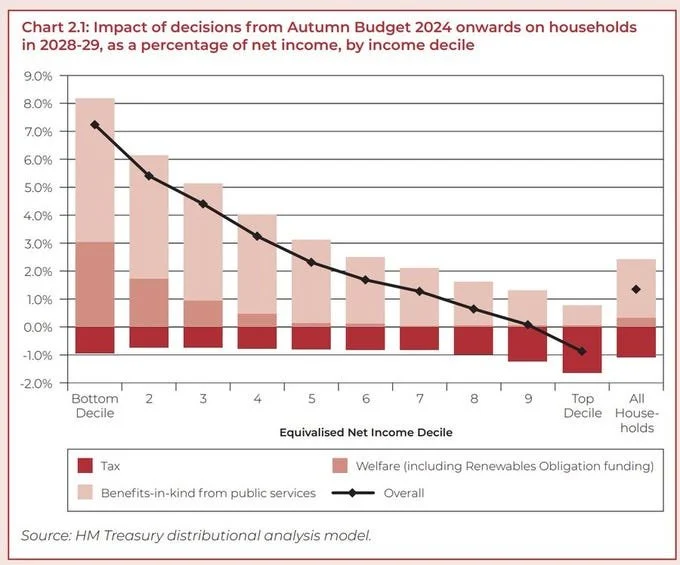
The result is a Budget that has a stronger Robin Hood flavour to it than anything else in Starmer’s 16 months of power. The Treasury’s distributional analysis of the combined impact of all the Budget measures unambiguously shows a chancellor who is taking from the rich to give to the poor (see below).
Yet this is not entirely a story of constraint. Because it turned out that the fiscal position the government faced was nowhere near as gloomy as the daily predictions for the past 5 months had suggested. While the OBR did reduce its over-optimistic productivity forecast, thus reducing expected growth by billions, this adjustment was almost completely balanced by much higher-than-expected tax revenues from strong wage growth.
Roughly speaking, the chancellor had to find £6bn to cover her existing fiscal rules. Yet in total, the Budget raised taxes over the parliament by £26bn. That’s £20bn in tax increases chosen by the chancellor rather than forced on her. So, what were these tax increases for?
Firstly, they were aimed at reassuring bond markets by more than doubling the headroom above her deficit rule. The reassurance seems to have worked: bond markets, after a flurry in response to the accidental leaking of the OBR documents 45 minutes before the Budget, responded with calm acceptance after the speech.
Secondly, the extra taxes were used to reduce poverty, specifically through the elimination of the 2-child cap on families’ universal credit claims. This will lift nearly half a million children out of poverty and its announcement received the biggest cheer from Labour backbenchers.
Thirdly, the chancellor assembled a collection of measures aimed at improving the cost of living for low- and middle-income families. Energy bills will be reduced by an average of £150 after many green levies were shifted onto general taxation. The Minimum Wage was increased by an above-inflation 4.1%. And both prescription charges and rail fares were frozen for another year. Taken together, this Budget package was the most focused package of cost-of-living focused interventions since Labour came to office. The OBR estimated that the combined effect of these measures will reduce inflation by 0.4% next year, a message that the chancellor will want bond markets as well as middle-income families to register and remember.
The tax increases themselves reflected another choice. Just three weeks ago, the Treasury briefing (and the coded implication of the chancellor’s curious 8am speech from Downing Street) led us all to expect that she had decided to break Labour’s manifesto commitment and raise one of the three protected broad-based taxes to finance her Budget measures. A few days later, the U-turn was itself U-turned, and the Budget ended up relying on a range of tax measures to generate £26bn of extra revenue - taxes on landlords, savers, EV-drivers, gamblers, sugar-drinkers and residents of houses worth over £2m. The two most notable tax measures are perhaps the most opaque and arguably the least directly ‘felt’: the imposition of NI contributions on salary sacrifice schemes and the extension of frozen Income Tax thresholds for a further three years.
Relying on a suite of smaller taxes for your tax revenue brings risks. They may not work technically or be watered down in consultation after lobbying. Expected revenue is considerably more uncertain if it comes from multiple sources. Many of these taxes are also backloaded to the end of the parliament, giving ample time for interested parties to press for their abolition or dilution, or for political circumstances to change. Bond markets would not take kindly to tax pledges in November 2025 disappearing one-by-one in the months to come.
There is also of course significant political risk in a tax-raising budget. The government will be embroiled in a row about whether the increases break their manifesto commitments from now until election day. Many of these taxes impact well-off urban voters, otherwise known as Labour’s electoral base, and voter backlash in next year’s local elections (in London especially) could be a cause for concern.
The Budget was silent on growth, surprising perhaps given how dominant a theme that has been for the Chancellor in all her set-piece moments and speeches since she took office. It was also disappointingly quiet on tackling the longer-term tax reforms (on council tax, business rates, multiple cliff-edges) that Britain desperately needs, and about which Labour enthusiastically pledged to reform when in opposition.
Of course, being a more avowedly progressive government brings both definition and risks. What is fascinating is that a hitherto risk-averse, cautious and rather technocratic government has made the decision to take the plunge, and become a tax-and-spend Government, in the name of tackling poverty, clamping down on the cost of living & turning around the NHS.
But more than that: it has knowingly walked into a position that its enemies can characterise as taxing Britain to pay for welfare. It is a characterisation they will resist vigorously on the airwaves and in parliament. But ultimately, the test of whether they can resist this label is the success of their next attempt at welfare reform, a battle that is surely going to be a major political moment sometime in the New Year.
Want to understand what the 2025 Budget means for your business or region? Get in touch with our team of experts to help you navigate the potential risks and seize opportunities opened up by the government’s latest budget.