
At the budget yesterday, Rachel Reeves announced a £26bn package of tax rises to pay for increased public spending and greater fiscal headroom. One measure that captured a lot of headlines was a new “mansion tax”: from April 2028, owners of properties in the UK valued at over £2 million will pay the new tax, ranging from between £2,500 and £7,500.
How will it work?
The tax will take the form of a recurring annual charge which will be additional to existing council tax liability and will feature four price bands. Properties valued between £2mn and £2.5m will face a charge of £2,500 while more expensive properties worth £5m or more will be taxed £7,500. More than 100,000 properties are expected to be affected by the change.
The property values will be based on new valuations to be carried out by the Valuation Office and will reflect their value in 2026. These values will then be used to sort properties into one of four bands. Those worth £2 - £2.5 million will have a surcharge of £2,500; £2.5 - £3.5 million of £3,500; £3.5 - £5 million of £5,000; and those worth £5 million of £7,500.
What are the political implications?
Some type of ‘mansion tax’ has been called for in Labour circles for some time - notably mooted by Ed Miliband when he was leader back in 2014. It is designed as a signal Labour are on the side of ordinary people, and are not afraid to go after the ‘super rich’. But could it politically backfire?
Bradshaw Advisory’s new analysis of Land Registry price-paid data, matched to constituency boundaries, shows how sharply exposure to a prospective mansion tax is concentrated in Labour’s urban strongholds in London and the South East.
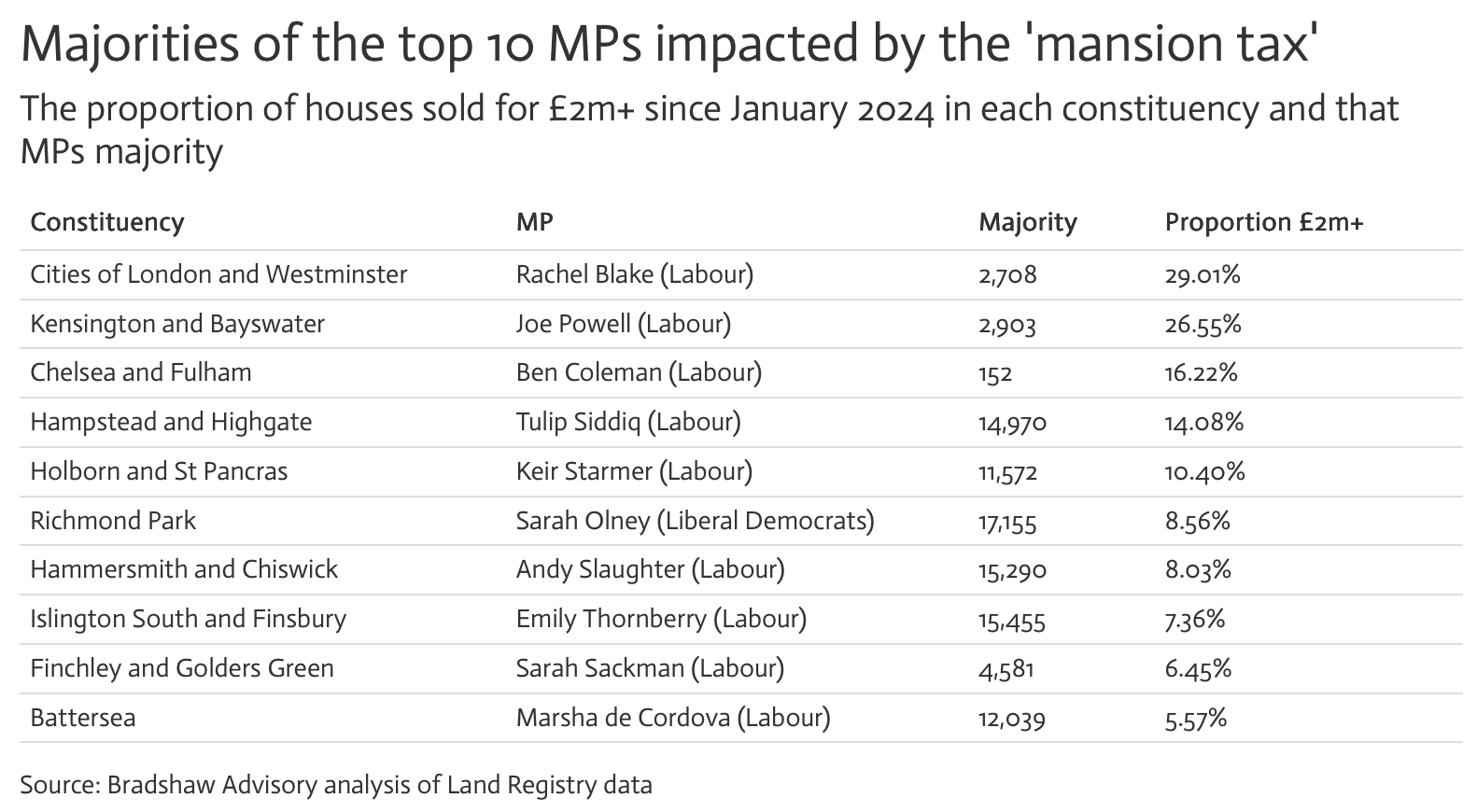
By calculating the share of transactions above £2m in every Westminster seat, our analysis places Cities of London and Westminster, Kensington and Bayswater, and Chelsea and Fulham at the top of the rankings, with between 16 and 29% of recent sales clearing the threshold.
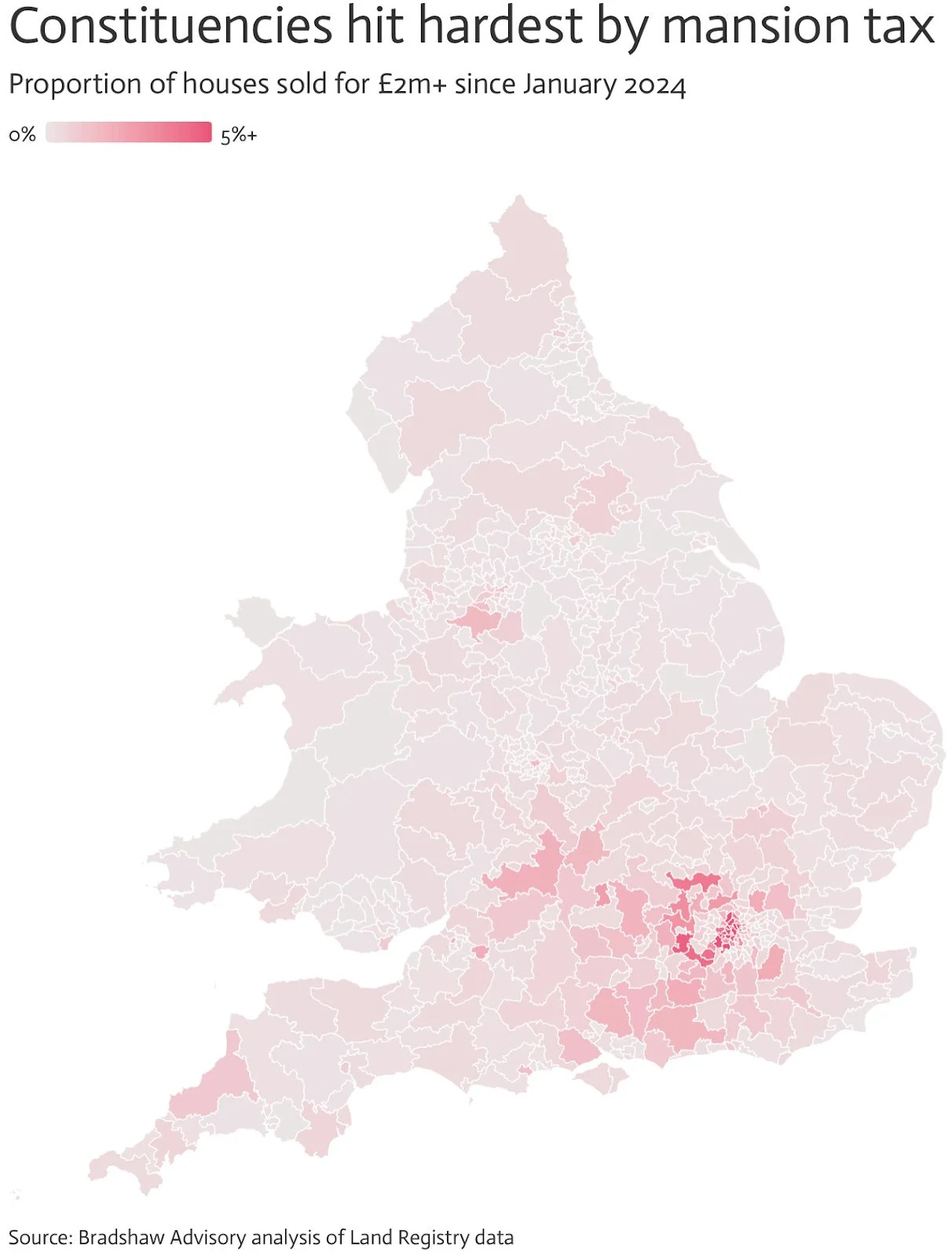
Several of Labour’s top brass and rising stars represent constituencies high on the list, including Keir Starmer, Rachel Blake and Emily Thornberry.
With borough elections due next year, the concentration of high-value property owners in key wards adds yet another layer of political complexity. The Parliament as a whole has an unusually large number of marginal seats. The newly elected MP in 2024, Ben Coleman, sits on a tiny majority of 152 in Kensington and Chelsea. It’s measures like this which could the Budget so consequential.
Our analysis was covered by The Guardian and The Spectator. Please contact matthew.brighty@bradshawadvisory.com for the full dataset.